
Understand Weekly Finances and Protect Your Cash
Updated · 1.2.1 Beta preview (source reviewed)
Mechanics checked against the 1.2.1 Beta preview source on 7 July 2026. Public and older builds can differ; use the values in your own save. Screenshots show earlier beta interfaces and may differ in appearance.
Why am I losing money after a good show?
A well-rated show and a profitable week are different outcomes. Match quality measures the performance of your content; cash flow also depends on attendance, ticket prices, contracts and operating costs. Start with the finance report and identify the line that changed rather than treating every loss as a booking problem.
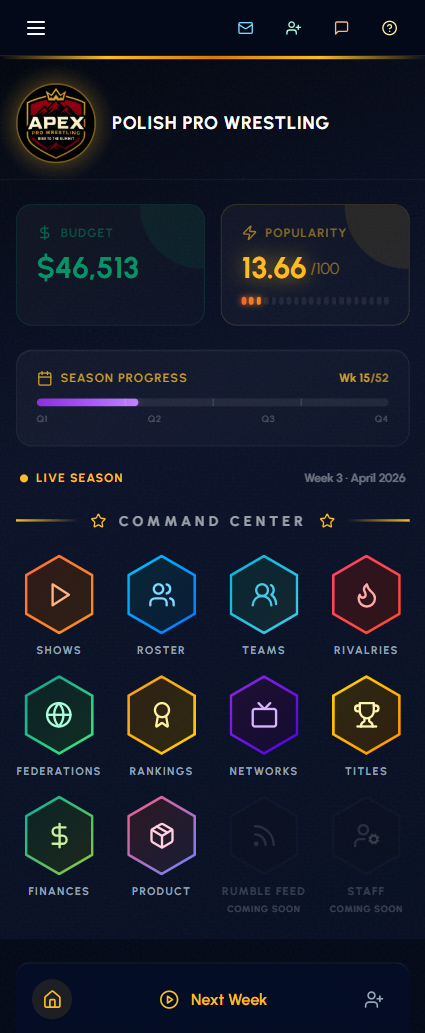
Know what comes in and what goes out
Ticket sales depend on attendance and ticket price. Broadcasting contributes where you have an applicable deal. Merchandise can include online sales and sales linked to shows. Treat additional revenue systems as available only when your own build and agreements show them.
Expenses can include weekly wrestler pay, booked appearance fees, staff, venue costs, wrestler merchandise payouts and product spending. Read the projection's categories; a signing payment or upgrade is different from an obligation that returns every week.
A worked weekly example
These are illustrative figures, not promised game income.
| Item | Amount |
|---|---|
| Ticket income | 4,000 |
| Applicable broadcast income | 1,000 |
| Merchandise income | 1,000 |
| Total income | 6,000 |
| Weekly wrestler salaries | 3,000 |
| Appearance fees | 1,000 |
| Venue and other operating costs | 4,000 |
| Total expenses | 8,000 |
| Net change before other transactions | −2,000 |
A 20,000 balance would cover ten identical losses mathematically, but new purchases or a worse show shorten that runway. Do not interpret that calculation as a safe deadline to spend everything. Reduce the recurring gap while you still have options.
Diagnose the loss
If venue spending is high relative to ticket revenue, consider whether the audience supports the venue. If payroll dominates, revisit roster size and contract use. If a single upgrade explains the loss, separate that purchase from the recurring weekly result before cutting a useful wrestler.
Compare the projection before advancing with the completed report afterwards. Forecast revenue can differ from the outcome. Write down the biggest difference and use it to improve the next forecast.
Keep a reserve for your own commitments
There is no single reserve amount that suits every save. Work out upcoming guaranteed payments, expected show costs and renewal or signing plans. Decide how much cash must remain available even if the next event earns less than you hope.
Before taking a new contract, add its total weekly effect to the projection. A cheap-looking wrestler can be expensive if several people already fill the same role.
Tax is based on profit
The reviewed source applies progressive weekly tax to positive net profit. The first 50,000 is untaxed, the next band to 200,000 is 5%, the band to 500,000 is 10%, and the part above that is 15%. Each rate applies to its band, not the entire balance. For example, 60,000 of taxable weekly profit gives 500 tax under those bands.
Use the tax shown in the game's report as the final figure for your build. A negative week is not taxed as if your total cash balance were profit.
What to do before the next show
Check cash, fixed payroll, scheduled appearances and venue. Compare the forecast with the last completed report. Change the largest controllable cost first, then check that the new plan leaves enough available talent to run the show.
Continue with the contract comparison guide, booking guide, or all player guides.