
How to Play Wrestling GM
Updated · 1.2.1 Beta preview (source reviewed)
Mechanics checked against the 1.2.1 Beta preview source on 7 July 2026. Public and older builds can differ; use the values in your own save. Screenshots show earlier beta interfaces and may differ in appearance.
What should I do in my first session?
Aim to complete one affordable show and understand its results before expanding. A large roster creates recurring commitments immediately; an impressive-looking card does not guarantee profit. Follow the decisions below in order and stop to check your numbers at each stage.
1. Create your GM and choose a difficulty
Create your General Manager profile, then name your federation and choose its identity. Read the difficulty description before confirming. In the reviewed preview, the three starting budgets are 80,000, 50,000 and 25,000; the 50,000 figure is not universal. Use the actual balance in your save for every purchase decision.
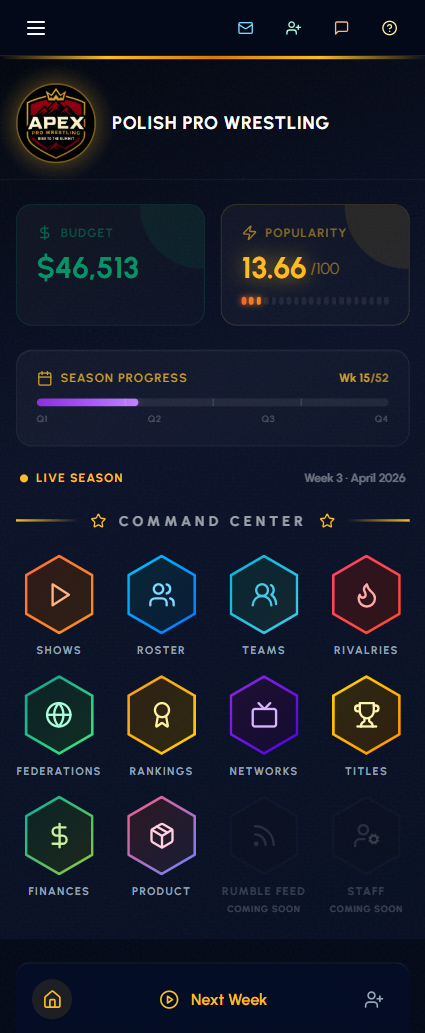
Open the dashboard and locate the roster, show booking and finance sections. Your first goal is to learn the weekly loop before expanding.
2. Plan a small roster before signing
Choose enough available wrestlers to fill a modest card without booking the same person repeatedly. For example, six wrestlers can supply three singles matches. This is a suggested learning card, not a minimum required by the game.
Compare each wrestler's skills, popularity, stamina and proposed contract. Weekly salaries and per-appearance deals create different commitments. Check signing bonuses, appearance limits and any promises before accepting. Keep cash for the venue, the show and the next weekly settlement.
Use the roster and contract guide to compare two offers over the same period.
3. Create the show and inspect its costs
Open Shows and create a weekly show. Choose a venue your current audience can reasonably support and review the cost shown by the game. Do not assume a larger venue will fill itself. Check the show date and any broadcast arrangement shown in your build.
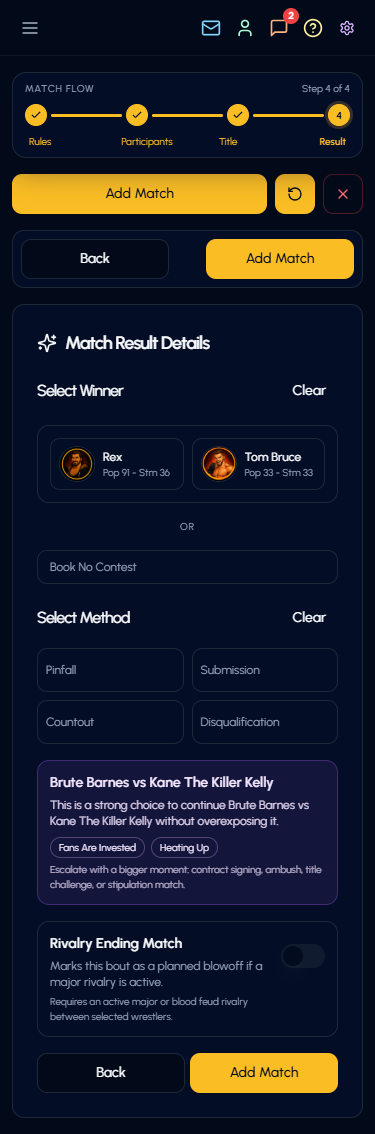
Start with standard matches while learning the system. Add participants, choose your intended finish and save each match. If you use AI booking assistance, review its participants and costs before running the card.
4. Give the card a purpose
For the six-wrestler example, use an opener to introduce a prospect, a middle match to develop another pairing, and your strongest suitable pairing in the main event. If you add a promo, pick someone who can carry it through charisma. These are creative choices; the game does not award a fixed bonus simply for following this example.
The booking and rivalry guide explains how to keep a feud moving without repeating the same match every week.
5. Run the show and read the breakdown
Run the completed card and inspect each match or segment result. Compare the result with the estimate shown during booking. Open the rating breakdown: it explains which inputs contributed, which is more useful than guessing from the winner alone.
Record one thing to improve next time. If talent skills are the weak part of the breakdown, a more expensive stipulation is not the same decision as signing a stronger wrestler. Read the rating guide before making that purchase.
6. Review finances before advancing
Inspect the weekly financial projection, including salaries, appearance fees, venue costs and product spending. Advance when you understand the expected cash change. Compare the completed report with the forecast; attendance and other outcomes can make estimates differ from results.
For example, projected income of 6,000 against expenses of 8,000 means a 2,000 loss for the week. With 20,000 remaining, ten identical losses would exhaust the balance before any unexpected purchase. This is illustrative arithmetic, not an income promise.
7. Improve one weakness at a time
Check health, stamina, morale and expiring contracts before booking again. Consider training a wrestler who is not essential to the next card. The reviewed preview offers a one-week standard camp, a two-week enhanced camp and a one-week intense camp. Inspect the fee, availability and stamina effect in your own build instead of assuming all training takes four to eight weeks.
Avoid spending the entire starting balance, treating projected ticket sales as guaranteed, and signing talent without a role. Keep the first few weeks small enough that you can explain where the money went.